
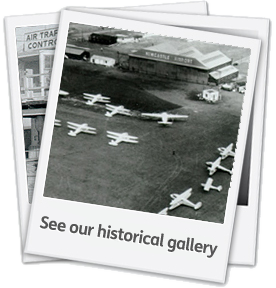
Northumbria Flying School has a rich heritage in the UK. In 2010 we celebrated the 85th Birthday of Newcastle Aero Club, now Northumbria Flying School. We hope you enjoy reading the next few pages that are dedicated to preserving some of the glorious memories that have been made in the past decades. Drop in and see some of our historic images and memorabilia in our club house.
1920-1939
1920s
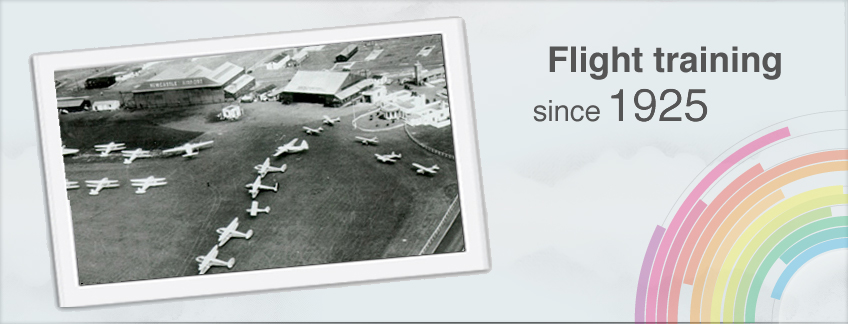
Newcastle Aero Club was founded in 1925, with the establishment of an airfield in Cramlington. With the opening of Newcastle Airport in Woolsington ten years later, the Aero Club relocated to its current site. It boasts the enviable record of being the oldest flying club in the country.
1930s
Newcastle Airport was opened on 26 July 1935 by Secretary of State for Air, Sir Phillip Cunliffe-Lister. The airport cost £35,000 to build and consisted of a grass runway, clubhouse, hanger, workshops and a garage. The runway lights consisted of a series of empty oil drums that could be filled with oil rags and lit in advance of an approaching aircraft!
The first scheduled service calling at Newcastle Airport was a flight between Croydon and Perth, Scotland, operated by North Eastern Airways using an 8 seater Airspeed Envoy aircraft. These aircraft operated of out the Aero Club's building.
1941-1959
1940s
The airport was requisitioned as an auxiliary wartime base for the RAF during the Second World War. When it was handed back in 1946 it had a new wooden air traffic control tower that was built on stilts and supported by sections of railway lines.
1950s
The 1950s saw the start of package holidays, with 'exotic' trips to Isle of Man, Isle of Wight and Channel Islands becoming available from Newcastle Airport. By 1954, scheduled services totalled some 35 per week. Passenger number reached 5,500 a year.
1960-1979
1960s
A new North East Regional Airport Committee was formed in April 1963, paving the way for major development. The new Committee, comprising the local authorities of Newcastle, Gateshead, South Shields, Northumberland, Durham, Tynemouth and Sunderland, shifted the fundamental nature of the airport, making it a springboard for regional development.
Construction of the new terminal complex was completed in 1966. On February 17, 1967, Prime Minister Harold Wilson officially opened the new terminal building.
The 1960s saw a boom in foreign sunshine holidays, especially to Spain. Within six years passenger figures had doubled to 700,000 per year.
1970s
In 1978 the Government designated Newcastle Airport Category B status which meant it became a regional international airport with a mandate to provide short and medium-haul scheduled international services.
By November 1978, a visionary expansion plan had been drawn up, with a 4,000 sq m terminal expansion as its centrepiece. It featured a new passenger pier and an airside departure lounge. The £8m development attracted £2m support from the European Community.
In the 1970s the arrival of jet aircraft triggered major expansion in the package holiday market. The first wide-bodied jumbo jet landed from America with a party of 380 people onboard.
1980-Present
1980s
A new parallel taxiway was constructed to speed aircraft turnaround times and greatly simplify ground manoeuvres.
Jim Denyer retired in 1989 and his role was filled by Trevor Went. Under Trevor Went’s stewardship, the airport placed considerable emphasis on expanding its network of scheduled routes, both domestic and international. Towards the end of the decade passenger numbers had reached 1.6 million a year.
1990s
In 1991 Nexus constructed an extension to the Metro system linking Newcastle Airport to the city & beyond, dramatically improving rail access to the airport.
In 1991/92, while some airports in the midlands and south of England recorded traffic losses of more than 20 per cent in the wake of the Gulf War and recession at home, Newcastle Airport was busy recording an impressive rise in traffic to a new record of 1.67 million passengers per year.
Whilst the number of passengers on both domestic and international scheduled routes had continued to show steady growth, the increase in charter holiday traffic was astounding, up 43 per cent in 1992/93 compared with the previous year. By 1993, passenger figures had hit 2 million.
Based on a turnover of £25.6 million Newcastle International was now ranked 117th largest company in the North East and 39th based on profit.
An extended and improved terminal building was opened on May 26, 1994 by the Princess Royal.
2000's
At the turn of the millennium, the Aero Club is thriving with over 400 active members. Then followed a bleak period in the history of general aviation at Newcastle. The Aero Club enters into financial difficulty in Christmas 2004. A former Chairman of the club during it's heyday decides to invest and restart the club on a clean slate with an emphasis placed on friendliness. The new club stands in the same premises as before using, superb equipment and employing the same dedicated frontline staff as previously. The club has a healthy base of over 200 members with regular social and educational meetings for all tastes.
The acquisition also brought the original 1930s airport terminal building back under the airport’s ownership. The airport announced plans to restore the building to its former 1930s glory and open it up as visitor centre with a viewing area overlooking the airfield.
 |
|
Follow Us... |
   |